Prologue
What this site is — and why
"AKTE EINTRACHT" is for lovers and haters of the SGE alike. History becomes legend, legend becomes myth. And myth becomes cult — or a reason for eternal second-hand embarrassment, depending on the event.
Solid looks different — but so does boring. The "FC Hollywood" of the Main. Europa League winners 2022, legendary European cup triumph in 1980, but also relegations, financial chaos and a managerial merry-go-round. Eintracht Frankfurt is the club that swings between ecstasy and disillusionment like no other — and whose fans turn every match into an experience.
But this site goes beyond mere celebration or hatred. Akte Eintracht is structured in three parts: The Club Dossier tells the story — triumphs, tragedies, scandals, heroes and failures across 12 chapters. Match Intelligence delivers the live data a professional needs: squad, statistics, head-to-head, injuries, form. And Predictions brings it all together — with prediction markets.
Prediction markets are not gambling. In traditional sports betting, the masses lose — the money goes to the bookmaker who has built in his margin. Betting exchanges are similar: commissions on winnings, liquidity shortages and spread eat into returns. Prediction markets work fundamentally differently. There is no bookmaker who lets the house win. Instead, money flows from those who don't know to those who get it right — with risk management, portfolio diversification and disciplined capital deployment. You can trade 24/7, build and close positions, and wait for the binary resolution of the event. Those who understand it are not speculating — they're engaged in systematic trading.
Akte Eintracht is part of Akte Bundesliga — the same concept for all 18 Bundesliga clubs. Each club gets its own dossier, its own intelligence, its own predictions. The big picture can be found at aktebundesliga.net.
Profile
Facts, figures and milestones
Steckbrief – Facts, figures and milestones
Eintracht Frankfurt — formerly also known as Sportgemeinde Eintracht or SGE for short — is one of the great traditional clubs in German football. The club colours are red, black and white. The crest features the Frankfurt Eagle (in red and white).
The playing kit is traditionally black-red or black-white. The professionals' home matches are played at the Commerzbank-Arena, formerly known as the Waldstadion, located in the Frankfurt city forest in Sachsenhausen-Süd. The arena holds 51,500 spectators and served as a venue at both World Cups held in Germany in 1974 and 2006.
Eintracht Frankfurt have more than 80,000 members (as of December 2019), placing them ninth among Germany's largest sports clubs by membership. The "profit-oriented" professional football corporation was established on July 1, 2000. Shareholders include the registered Eintracht Frankfurt association (67.88%), the Freunde des Adlers GmbH (18.55%) and additional stakeholders.
Since September 1, 2015, the AG has been led by a three-person executive board. This board is supervised by a nine-member supervisory council including representatives of the owner (the club), the City of Frankfurt and the State of Hesse.
Good to Know
What few people know
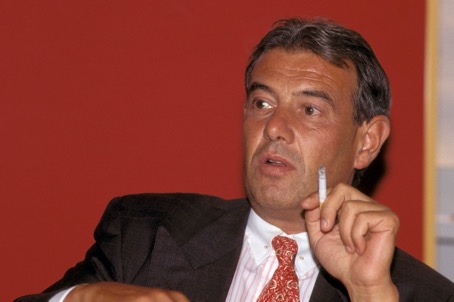
Since the 1990s, Eintracht have repeatedly fought for their sporting and financial survival. The club has attracted some truly distinctive characters — as players, managers and presidents. That much is known. Less well known are the circumstances surrounding the appointment of the club's most scandal-ridden president. In 1988, Matthias Ohms took office — and brought chaos in his wake.
Ohms was responsible, until his resignation following the 1996 Bundesliga relegation and a successful vote of no confidence, for both the most successful and the most tragic chapter in Eintracht's Bundesliga history. With a mix of megalomania, red-light-district connections and dubious personnel decisions, he was a perfect fit for the scandal club from the Main.
DER SPIEGEL summed up the special Eintracht atmosphere under Ohms as follows: "Under Ohms's leadership, Frankfurt's moneyed aristocracy and its nocturnal aristocracy entered a fatal alliance." An open secret whispered around the Eintracht scene during Ohms's tenure: parties with figures from the red-light world took place at his house — and valuable Eintracht memorabilia mysteriously disappeared.
Like few other Bundesliga clubs, Eintracht Frankfurt unite triumph and tragedy. The "capricious diva" has a knack for squandering seemingly certain successes throughout their turbulent league history — providing haters with the finest material. Conversely, the club can also wriggle free from apparently hopeless sporting situations time and again.
Also little known: Eintracht hold a very special Bundesliga record. As of December 2019, they are the club with the highest combined total of goals scored and conceded in a single Bundesliga season. In 1981/82, they scored 83 goals and conceded 72 — 155 goals in total. Pure entertainment.
30. What is not particularly difficult for a currency trader with the corresponding leverage typically used in intra-day trading.↩
For the Haters
Embarrassing disasters and major defeats
Twice 0-7: The biggest Bundesliga humiliations for Eintracht are the two 0-7 record defeats — thrashings that haunt the club's history.
0-5 in the UEFA Cup: On the international stage, the 0-5 defeat at Danish outsiders Brøndby IF in the UEFA Cup in the 1991/92 season represents one of the most embarrassing European nights in the club's history.
Longest losing streak: Eintracht Frankfurt suffered seven consecutive defeats from matchday 12 to 18 in the 2003/04 season — a run of misery.
Most defeats: Eintracht Frankfurt suffered 20 defeats in the 2003/04 season.
Longest winless run: The SGE went 17 consecutive Bundesliga matches without a victory in the 1983/84 season — a record that tested even the most loyal supporters.
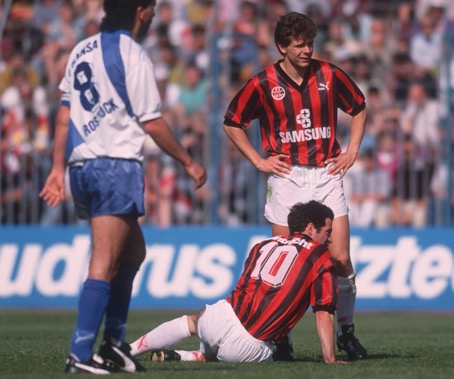
1-6 against a third-division side: In 1996 and 2000, Eintracht Frankfurt were eliminated from the DFB-Pokal in the first and second round respectively with 1-6 defeats by lower-league opposition — humiliations that became running jokes.
There is no Rostock and there never was a Rostock: May 16, 1992 has been erased from Eintracht Frankfurt's official club chronicles. The relegation-sealing defeat at Hansa Rostock is a trauma the club prefers to forget.
Relegation 1995/96: The first Frankfurt relegation season in 1995/96 produced a then-worst haul of 32 points — a dismal campaign that ended in the drop.
Worse still? Yes! The relegation season of 2003/04 set several negative records from a Frankfurt perspective — eclipsing even the misery of 1996.
For the Lovers
Key triumphs and major victories
UEFA Cup 1979/80: Eintracht Frankfurt's greatest international success is the UEFA Cup triumph in the 1979/80 season — a victory over Borussia Mönchengladbach in an all-German final that remains the high point of the club's European history.
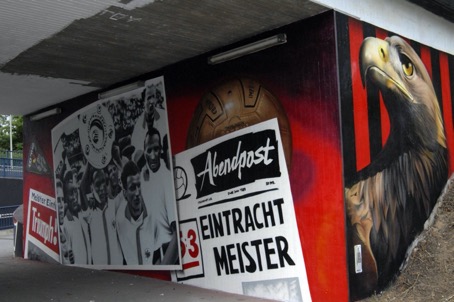
Five DFB-Pokal triumphs: Domestically, five DFB-Pokal victories (1974, 1975, 1981, 1988, 2018) and above all the German championship of 1959 represent the pillars of the club's trophy cabinet.
German champions against Offenbacher Kickers: The German championship, won on June 28, 1959 in Berlin with a 5-3 victory against the cross-city rivals Kickers Offenbach, remains the pinnacle of Frankfurt football.
European Cup of Champions: A year later, Eintracht Frankfurt became the first German team to reach a European final, facing Real Madrid at Hampden Park in Glasgow. The 3-7 defeat was no disgrace — it remains one of the most celebrated matches in football history.
No panic on the Titanic: Referee Daniel Stolpe took charge of the Eintracht Frankfurt vs. 1. FC Kaiserslautern match on the final day of the 2015/16 season. Frankfurt needed a win to stay up — and got it, producing one of the club's most dramatic survival stories.
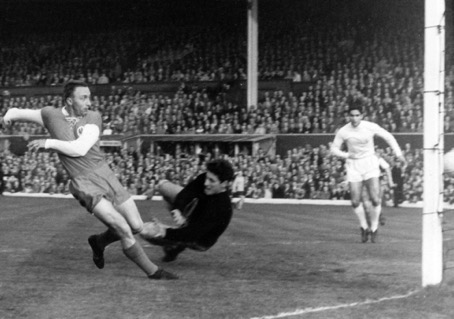
"Fußball 2000": "Eintracht embodies a very specific playing style. And it is called: beautiful football," said SGE legend Bernd Hölzenbein. The initiative "Fußball 2000" under coach Dragoslav Stepanović became synonymous with the club's most entertaining era.
Okocha-cha-cha: Few Eintracht goals have been replayed on TV as often as Jay-Jay Okocha's irresistible solo run against Karlsruher SC in 1993 — a goal of such audacity that it transcended the club and became a piece of Bundesliga folklore.
The Euro Eagles: No other German club had achieved what Eintracht managed in the Europa League group stage — winning all six group matches. The Eagles' European campaign of 2018/19 captured the imagination of football fans far beyond Frankfurt.
The relegation master: No other club has shown such nerve in Bundesliga relegation play-offs as Eintracht Frankfurt. Time and again, the Eagles have pulled themselves back from the brink in the most dramatic fashion.
Most Important Persons
The men who shaped the club
The proud one: From 1990 to 1995, the Ghanaian striker led the Eintracht attack. He made 123 Bundesliga appearances in the Eintracht shirt, scoring 68 goals. Together with Uwe Bein and Andreas Möller, he formed one of the most feared attacking trios in Bundesliga history…
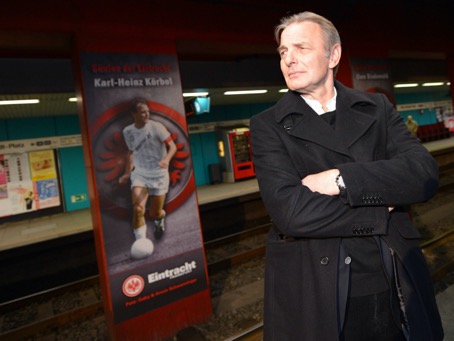
The loyal one: "Charly" Körbel played his entire professional career exclusively for Eintracht Frankfurt, holding the seemingly eternal Bundesliga record of 602 appearances. Equally remarkable: in all his competitive matches, he was never sent off…
The icon: Pfaff was the first of three World Cup winners from Eintracht Frankfurt. He was part of the German squad that beat Hungary 3-2 in the 1954 final. Pfaff featured in the group stage and became an Eintracht legend, representing the golden age of Frankfurt football…
Cry baby! The Frankfurt-born midfielder joined from local rivals BSC Schwarz-Weiß as a junior in 1981 and was promoted to the first team four years later. He stayed two more years before leaving for Borussia Dortmund — a departure that still stings in Frankfurt…
The flamboyant one: The Hungarian left his homeland after the 1956 uprising and arrived at Frankfurt Hauptbahnhof on December 17, 1956. The flamboyant character stood out not only for his outfit. After his suspension expired, he became one of the most colourful figures in Eintracht's history…
The talent developer: The man with a flair for youth remains welcome on the Main 30 years after his departure. Weise coached Eintracht twice (1973–76 and 1983–87) and was responsible for their first DFB-Pokal triumphs — laying the foundations of a cup tradition…
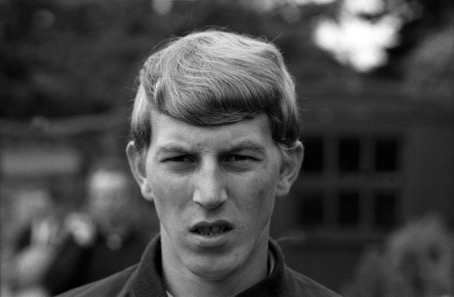
Personae Non Gratae
The men fans love to hate
The dark abbot: The former Eintracht assistant coach made a name for himself as a rather shady player agent. Known as the "Black Abbot" — occasionally dubbed the "White Abbot" by RTL for variety — his own prominence always took priority over his clients' interests…
The scandal referee: It was May 16, 1992, when referee Berg traumatised Frankfurt fans for decades with a non-call. At Hansa Rostock, Eintracht played their final match of the season needing a result to stay up — and Berg's decision sealed their fate…
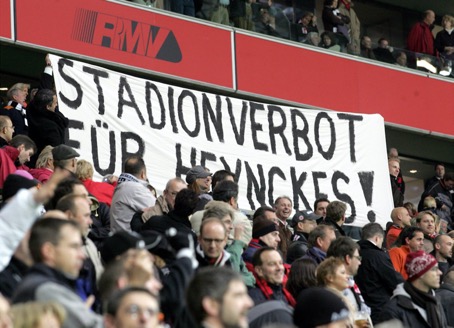
The unsuccessful ones: "End the FANZ farce" and "ROHR-krepierer FirleFANZ" were merely the tip of the creative iceberg from Eintracht fans in 1999. In capital letters on banners, they vented their fury at coaches Horst Franz and Gernot Rohr — who between them oversaw a disastrous period…
The shambles: Embarrassing, more embarrassing, Heynckes. "When I start here in Frankfurt, the clocks will tick differently," Jupp Heynckes announced upon taking charge in July 1994. In the end, the club was relegated — the most humiliating chapter in Heynckes's early career…
The Mainz man: Michael Thurk was a wanderer between Mainz 05 and Eintracht Frankfurt. And he was a Mainz playing legend. Between 1999 and 2006 he made 202 appearances for the 05ers and was one of the heroes of their first-ever Bundesliga promotion…
The interior minister: Peter Beuth, Hesse's interior minister in 2019, and the Frankfurt fan scene were not the best of friends. Before the Europa League match against Shakhtar Donetsk on February 21, 2019, a showdown erupted — with Beuth's heavy-handed policing approach infuriating the Eintracht faithful…
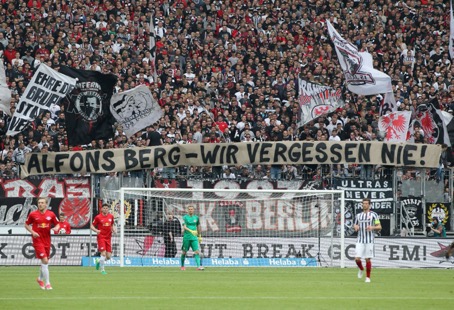
Tragic
Those who suffered misfortune
Cha Bum-kun — the swindled one: Financially damaged by his own vice-president. Eintracht vice-president Wolfgang Zenker, in his capacity as a representative of a major property group ("Südfinanz"), had lured more than 80 football professionals into risky investments through so-called "developer models." At the end of the weak 1982/83 season, he ousted the coach — leaving a trail of financial ruin among the players he was supposed to protect.
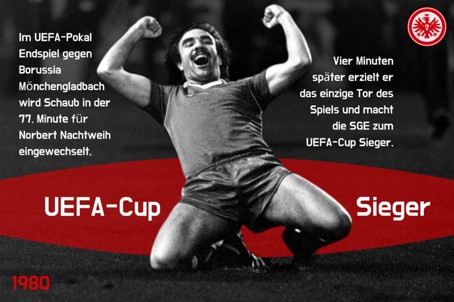
Fred Schaub — the car accident: Fred Schaub joined Eintracht Frankfurt from SV Neuhof in 1976. On January 13, 1979, he made his Bundesliga debut and scored two goals in ten appearances by the end of the season. The following season, Schaub was only a squad player with six Bundesliga appearances. Nevertheless, his talent was beyond doubt — until a devastating car accident cut his career brutally short.
OMG — Oh My God
You can't be serious
The Eintracht — sometimes "Zwietracht Zankfurt" ("Discord Quarreltown"), but often also a genuine Frankfurt thriller. Sometimes with, sometimes without a "shadow man," as in Dieter Wedel's 1995 TV series of the same name. In the leading roles: an alleged car fence, a vice-president who financially ruined his own players, a Hungarian record transfer who never justified his fee, and a national team player arrested after a TV show.
"Gottschalk Late Night" with Gaudino: No, Maurizio Gaudino's time at Eintracht was no success story — more of a crime story made in Bembeltown! Signed from VfB Stuttgart in 1992, the German international was arrested immediately after appearing on the RTL talk show Gottschalk Late Night in December 1994. The charge: suspected insurance fraud.
Fired — but "Scheppe" won't open up! Heavily indebted despite selling superstar Lajos Detari, who left after just one season (33 Bundesliga matches, 11 goals), coach Karl-Heinz Feldkamp was sacked on September 13, 1988. He had refused to sign a player he hadn't scouted first. Five days later, Feldkamp's successor arrived — inheriting a club in turmoil.
The Detari millions, or "It's all just borrowed": The Hungarian Lajos Detari had won Eintracht Frankfurt the 1988 DFB-Pokal with a free-kick goal against VfL Bochum. In mid-July 1988, the playmaker announced his departure — and transferred to Olympiakos Piraeus for the equivalent of eight million euros, ten days before the season started! The money vanished into the club's debts as quickly as it had arrived.
31. Übrigens: Es gibt auch Frankfurter Kreise, die behaupten, dass die SGE nicht ganz leer beim Detari-Transfer ausgegangen sei.↩
Fun Facts
Knowledge for blowhards, braggadocios and connoisseurs
Four coaches: In their first Bundesliga season after promotion from the 2. Bundesliga, Eintracht Frankfurt burned through four head coaches in 1998/99 — a managerial carousel that became a symbol of the club's chaos.
Quälix saves Eintracht: In the 1999/2000 season, the club, docked two points by the DFB for financial irregularities, stood on the brink of relegation. Felix Magath arrived and secured survival — earning the eternal gratitude of the Frankfurt faithful.
But it works both ways: In 2001, Eintracht were less fortunate and were relegated to the 2. Bundesliga for the second time — a blow that tested the club's resilience to the limit.
"Second half of shame": In the 2010/11 season, the club proved it could get even worse. After a weak first half, the Rückrunde was so catastrophic that it earned its own name — the "Rückrunde der Schande."
A real eagle: Since 2005, the club has had a live mascot — Attila, a golden eagle from the Hanau wildlife park. Attila circles the stadium before every home match, a spectacle unique in the Bundesliga.
Bad luck with partners: As a club partner, Aero Flight painted an Airbus A320 in the Eintracht colours in 2005. The airline went bankrupt shortly afterwards — taking the flying advertisement with it.
The stadium as museum: Since 2007, a museum has existed inside the main stand of the stadium, where Eintracht icons and memorabilia are displayed — a shrine for the faithful.
Deutsche Bahn: As a so-called premium partner, Deutsche Bahn painted a DB Baureihe electric locomotive in Eintracht colours in late August 2012 — a rolling advertisement across the German rail network.
Lifetime membership: Since 2012, for a one-off payment of €1,899 (the club's founding year), fans can acquire a lifetime membership — a popular option that underlines the deep emotional bond between club and city.
Special Moments
The clocks will tick differently — and Jupp Heynckes ruins the squad
In his practice near Munich's Marienplatz, FC Bayern club doctor Dr. Hans-Wilhelm Müller-Wohlfahrt receives an unexpected visitor one summer's day in 2013. At his door stands Jupp Heynckes, 68, former coach of FC Bayern München. Before retiring, the veteran manager had achieved something historic with Bayern — the Treble of German championship, DFB-Pokal and Champions League.
A grand gesture from a man who had shown he could change. Who seemed to have matured like fine wine. From the coaching novice with his clumsy rhetoric to the nearly unemployable job-hopper already branded a "coach of the old school" by Rudi Assauer in 2004 — and finally to the Triple-winning sage. But to understand the transformation, one has to go back to Frankfurt.
Of all places, Frankfurt! Nowhere did "Don Jupp" suffer a greater debacle than at the once-high-flying Hessian club. Nowhere in his career did the Rhinelander make himself more unpopular than at the Frankfurt Stadtwald. At no other club did his stubbornness leave more scorched earth than in the metropolis on the Main.
The Heynckes that Frankfurt's strict tabloid press and spoiled fans encountered at his appointment in July 1994 bore little resemblance to the relaxed coaching fox of his later years. Heynckes came across as pedantic, impervious to advice and aloof. "When I start here on July 7, the clocks will tick differently," he announced at his presentation. A promise that would come back to haunt him.
A slip of the tongue that would cost him dearly. At FC Bayern München in the spring of 1990, after winning the German championship, he had already allowed himself a rash promise. "I promise you," he called out to the Bayern fans at Marienplatz, "that we'll win the European Cup next year." The Bayern stars around Klaus Augenthaler shrugged — and in the end, Heynckes was sacked before he could fulfil the pledge.
Before long, Eintracht vice-president Bernd Hölzenbein brought his former international teammate Jupp Heynckes — with whom he had played eleven times for Germany — back to the Bundesliga. Eintracht Frankfurt had endured a turbulent season. The ambitious Hessian club had collapsed spectacularly after being "autumn champions" in 1993, crashing out of the UEFA Cup quarter-finals.
The notion of "calm within the club" would be shelved quickly. "This," SAT.1's RAN programme later summarised in characteristically florid style, "made even seven turbulent years under Stein look like eternal peace." But it was not just Heynckes's threat about the clocks ticking differently. "I haven't come here to finish fourth or fifth," Heynckes declared — raising expectations to breaking point.
The start was miserable. 0-0 against Köln, 1-1 at Kaiserslautern, and on matchday 3, Bayer Leverkusen with old stars Bernd Schuster and Rudi Völler blew Eintracht away 4-0. One detail stood out even in this match: Anthony Yeboah, the reigning Bundesliga top scorer, was not in the squad. Something between the proud Ghanaian striker and the authoritarian coach had broken irreparably.
"I'm gone from Frankfurt and now he can show what a world-class coach he is," Gaudino fired one last parting shot at Heynckes from Manchester. By then it was too late. On April 2, 1995, after a 0-3 defeat to Schalke and 13th place in the Bundesliga, Heynckes's time in Frankfurt was up. He brought his wife Iris to Frankfurt to draft his official farewell statement. "For me it is deeply painful" — but the damage was done.
For Eintracht, the appointment of Jupp Heynckes was a "very special moment" indeed. It marked the end of all championship ambitions and the beginning of a phase in which the club became a yo-yo team, fighting for its sporting and financial survival. Sometimes the fit simply isn't right.
32. Außer vielleicht in Mönchengladbach im Jahr 2007.↩
Wise Words
Quotes for eternity
„Du musst de Gegner so früh wie möglich angreifen, am besten schon beim Ball aufpumpen. Dragoslav Stepanović
als Trainer bei Eintracht Frankfurt„Lebbe geht weider" Dragoslav Stepanović
nach der verlorenen Meisterschaft 1992 in Rostock„Nach hinten habe ich viel mit dem Auge gearbeitet." Uwe Bein
in einem Interview 2012 über seine Defensivqualitäten als Profi"Bruda, I'm just gonna boot it long!" Kevin-Prince Boateng's answer to Ante Rebic before the 2018 DFB-Pokal final against FC Bayern
Rebic decided the match almost single-handedly with two goals"The bench signalled that we needed another goal. So I scored another one."
Jan-Aage Fjörtoft, after the 5-1 victory over 1. FC Kaiserslautern"Eintracht are blessed with bad luck."
Karl-Heinz Körbel, Eintracht icon